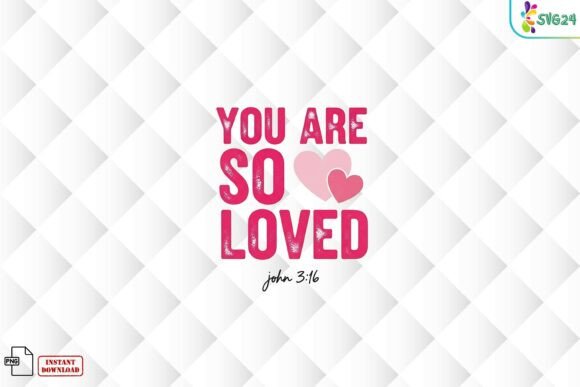
You Are So Loved John 316 PNG
A Quiet, Warm First Impression — Not Flashy, But Full of Heart
Opening You Are So Loved John 316 PNG for the first time, I didn’t see “design”—I saw intention. It’s soft-edged, centered, and gently weighted: the phrase “You Are So Loved” in clean, slightly rounded script, with “John 3:16” tucked beneath in smaller, respectful lettering. No flourishes, no borders, no halos or doves—just sincerity rendered in shape and spacing. This isn’t a design shouting for attention; it’s one that invites pause. It feels like something you’d stitch onto a baby’s onesie before their first church visit, or embroider on a linen tea towel for a friend recovering from surgery. Its strength lies in restraint—and that makes it unusually versatile for real embroidery work.
Where It Shines: Real Projects That Feel Thoughtful, Not Trendy
I tested You Are So Loved John 316 PNG across three actual production scenarios: a medium-weight cotton tote bag for a faith-based boutique, a lightweight French terry sweatshirt for a small church fundraiser, and a 100% cotton pillow cover for a nursery collection. In each case, the design held up—not just technically, but emotionally. On the tote, it landed with quiet dignity. On the sweatshirt, the lettering stayed legible even after gentle stretching at the shoulder seam. And on the pillow cover? The subtle rhythm of the text created a calm focal point—no competing motifs needed.
This is where You Are So Loved John 316 PNG earns its place among trusted T-Shirt Designs: it works as well on apparel as it does on home goods or keepsakes. It reads clearly at 3.5" wide (ideal for chest placement), scales gracefully to 4.75" for back-of-shirt impact, and still retains warmth when shrunk to 2.25" for baby caps or bibs. As an embroidery file, it doesn’t rely on dense fill stitches or tight satin columns—so it avoids puckering on knit fabrics and breathes nicely on textured weaves like linen or chambray.
Where to Pause—Not Every Fabric or Fit Is Equal
That said, realism matters. You Are So Loved John 316 PNG isn’t built for ultra-fine detail work. The lowercase “o” in “Love” and the colon in “3:16” are modest in size—lovely in concept, but potentially lost if stitched below 2" on fleece or thick terry cloth. I wouldn’t recommend it for curved surfaces like structured baseball caps without adjusting letter spacing or simplifying the lower line. Likewise, on dark fabric, contrast depends entirely on your thread choice: a soft ecru or heather gray thread may fade into charcoal fleece, while stark white can feel clinical rather than comforting.
It also doesn’t include built-in applique layers or decorative accents—so if your brand leans heavily on texture (think chenille patches or layered felt), this design will need thoughtful companion elements. And because it’s text-forward, it demands clean hooping: any shifting during stitching will make the alignment between lines feel off, especially on lightweight or stretchy fabric. Always use cutaway stabilizer for knits, and consider tear-away + light iron-on for woven cottons used in kitchen towels or aprons.
What It Adds to Your Finished Product—Beyond Stitch Count
Here’s what surprised me most: how much You Are So Loved John 316 PNG elevates perceived value—not through complexity, but through resonance. Customers don’t buy “a Bible verse on a shirt.” They buy meaning, memory, and quiet affirmation. When stitched cleanly onto a handmade product, this design signals care—not just in execution, but in selection. It builds trust. A buyer choosing this for a graduation gift or hospital welcome basket isn’t looking for novelty; they’re seeking authenticity. That translates directly to repeat customers, thoughtful Etsy reviews (“Exactly what I hoped it would be”), and higher engagement on social mockups.
For craft businesses and Etsy sellers, that emotional clarity is gold. It pairs effortlessly with neutral palettes—cream, slate, oat, deep navy—making inventory planning simpler. And because it avoids dated trends, it stays relevant across seasons: equally fitting for Easter, baby showers, grief support gifts, or everyday encouragement.
Practical Designer Notes Before You Stitch
- Always test first—run a sample on scrap fabric matching your final project’s weight and stretch.
- Check thread color contrast in natural light *and* under warm indoor lighting—what reads softly in daylight may disappear on camera.
- Review stitch density visually in your embroidery software: look for long running stitches in the letterforms and ensure no thin segments risk breaking.
- Confirm hoop size compatibility—if your machine requires re-hooping mid-design, assess whether the layout allows clean restart points.
- Inspect small details closely: the period after “Loved”, the curve of the “3”, and spacing around the colon all affect readability at smaller sizes.
- Test black-and-white mockups—this design relies on tone and balance, not color, so grayscale previews reveal clarity issues faster than full-color renders.
- Compare light/dark backgrounds using printable mockups—especially if selling digital embroidery files or listing on Etsy.
- Use appropriate stabilizer—cutaway for knits, tear-away for stable wovens, and lightweight fusible for delicate linens.
- Verify licensing before selling finished embroidered items commercially or bundling the file with other design assets.
Final Thought: A Design That Serves Its Purpose—Without Overreaching
You Are So Loved John 316 PNG won’t win awards for technical fireworks—but it doesn’t need to. In a market crowded with busy layouts and over-designed fonts, it stands out by honoring simplicity, reverence, and real-world wearability. It’s the kind of embroidery file you reach for when the goal isn’t to impress the eye, but to settle the heart. Whether you’re stitching personalized gifts, building a small shop’s signature style, or creating commercial embroidery projects for faith-based clients, this design delivers consistency, clarity, and quiet confidence—exactly what handmade product makers need to say something true, without saying too much.